
In this article
A well-built multilingual website has a complete, adapted version for each language, with its own URL (for example, /fr/ or /en/), hreflang markup linking the versions to one another, and copy written for each market, not just translated. That way, Google shows each visitor the right version, and the visitor finds everything they need to book in their own language.
For a hotel in Fátima, a rural guesthouse near Tomar or an experiences company in central Portugal, speaking the visitor’s language is often the difference between a direct booking and a booking through a platform. This guide explains how to do it without the mistakes that cost you visibility.
Which languages to choose
Don’t start with the list of languages you’d like to have. Start with the data you already have:
- Where your guests come from: your PMS or the booking platforms show which countries your guests come from.
- Browser language of your website visitors, in Google Analytics.
- Searches on your Google Business Profile and reviews: which languages do your customers write in?
- Official tourism statistics for your region, published by Statistics Portugal (INE) and Turismo de Portugal.
Fátima has a particular profile: as well as Portuguese, there is strong demand from Spanish-, French-, English-, Polish- and Italian-speaking visitors, for reasons linked to the pilgrimages.
Rule of thumb: three languages done well and kept up to date are better than eight incomplete ones. Each language is a maintenance commitment: prices, offers, opening hours and news all have to be updated in every version.
How to structure your URLs
Google recommends separate URLs for each language version, rather than switching the language of the same page with cookies or scripts. There are three common ways to do this:
Subfolders: example.pt/fr/
The simplest option, and the one we recommend for most hotels and SMEs. All languages share the same domain and the same authority, and the technical management is centralised.
Subdomains: fr.example.pt
This works, but it’s more work to manage and brings no clear advantage for a small business.
Country domains: example.fr
This makes sense for brands with real operations in each country. For a hotel in Portugal, it rarely justifies the cost and effort of building authority across several domains.
One detail that makes a difference: translate the URLs themselves too. /fr/chambres says more to a French visitor, and to Google, than /fr/quartos.
What hreflang is and why it’s essential
Hreflang is markup, invisible to visitors, that tells Google: “this page has these versions in other languages”. Without it, Google may show the Portuguese version to a French visitor, or treat the versions as duplicate content.
To work, hreflang has to follow a few rules, set out in Google’s documentation on localised versions of your pages:
- Each version points to all the others and to itself. If the French page points to the English one, the English page must point back.
- Correct codes:
pt-PT,fr,en,es,pl. An incorrect code is simply ignored. - A default version (
x-default) for visitors who don’t match any language. - Only link to versions that exist. If a page has no translation, don’t declare an alternate that leads to an error or to the home page.
Translation or adaptation?
Machine translation has improved a great deal, but a hotel website isn’t a technical document. It’s a conversation with someone deciding where to stay. Errors of tone, literal expressions and terms nobody searches for come across as careless, and guests notice.
What we recommend:
- Use machine translation as a draft, never as the final version.
- Have it reviewed by a native speaker who knows the sector.
- Adapt, don’t translate: a Polish visitor and an English visitor look for different things. Highlight what matters to each.
- Research keywords in each language. The way a Spanish visitor searches for a hotel near the Sanctuary isn’t a literal translation of the Portuguese search.
Our copywriting service handles adapting the copy, and our SEO service handles keyword research in each market.
Common mistakes we see on hotel websites
- Redirecting automatically based on browser language. It stops visitors from choosing and can stop Google from seeing every version. Offer a discreet suggestion, never a forced redirect.
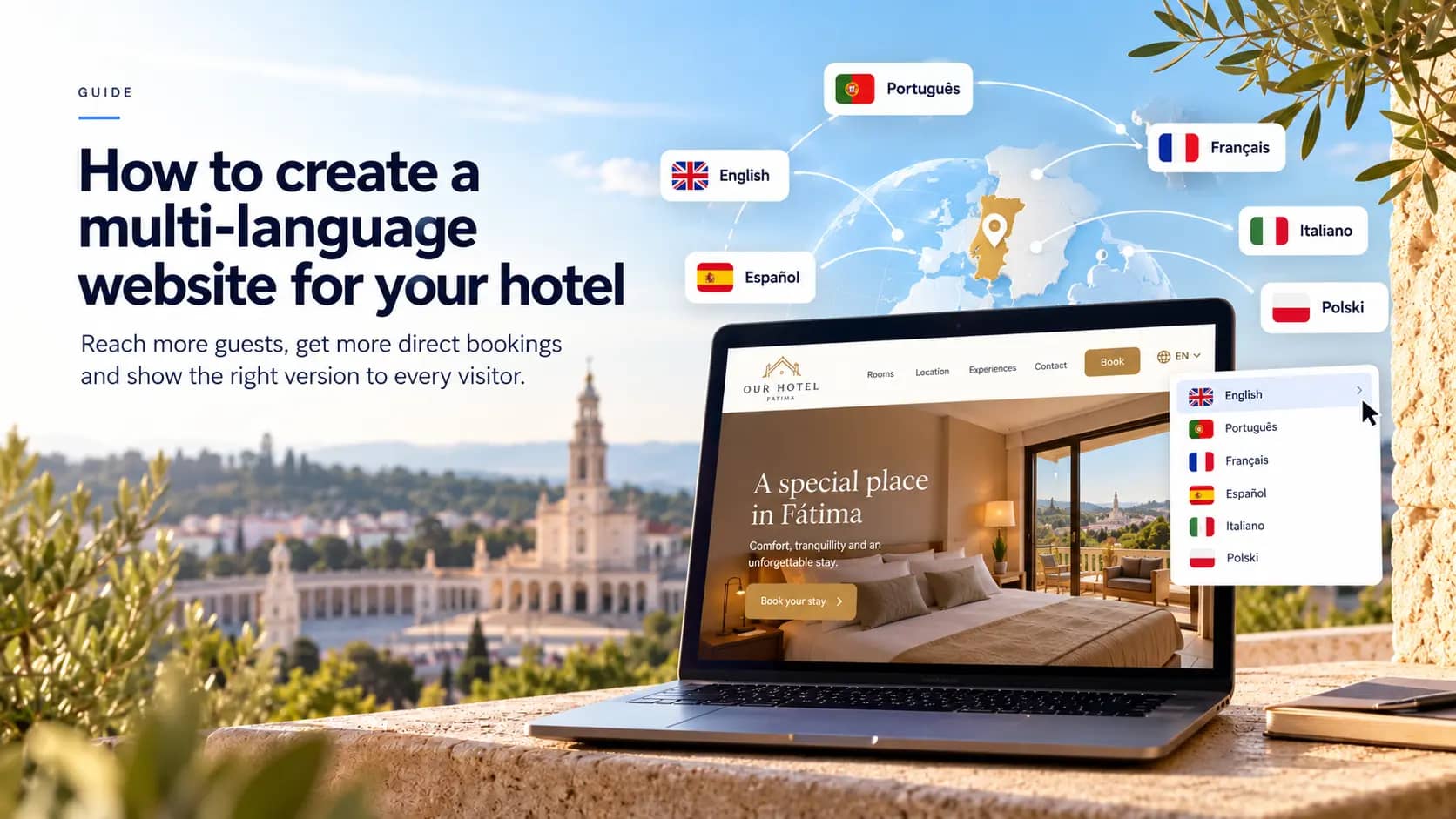
- Flags as a language selector. A flag represents a country, not a language. Use the language’s name in that language: Português, Français, English.
- A selector that always leads to the home page. Someone on the rooms page who switches language should stay on the rooms page.
- A booking engine in only one language. There’s no point in the website being in French if the final step is only in Portuguese.
- Untranslated metadata. The title and description shown on Google need to be in the right language too.
- Abandoned versions. Prices from two years ago on the English version put people off more than having no English version at all.
Pre-launch checklist
- Each language has all the essential pages: rooms, location, bookings, contact, terms.
- Translated, consistent URLs.
- Reciprocal hreflang on every page, with
x-default. - A unique title and meta description in each language.
- Booking engine, confirmation emails and automated messages in the guest’s language.
- A Google Business Profile with a description written for people searching in other languages.
- Speed checked on every version, especially on mobile.
An example at scale
The official Visit Marrakech portal, which we developed, is available in more than 12 languages. The principles are the same as for a small hotel: a clear URL structure, correct hreflang and content designed for each market. Only the scale changes.
For a hotel or holiday rental, the starting point is usually simpler. Our web design service includes Portuguese, English and French versions as standard, on a business website of up to 8 pages, from €2,900 + VAT. Other languages are quoted separately. To see how this fits into your booking strategy, also read our guide on direct bookings.
Frequently asked questions
Can I just use an automatic translation plugin?
You can, but it isn’t advisable as a final solution. Unreviewed machine translations contain errors of tone and vocabulary that put guests off and don’t match what people actually search for. Use them as a draft and have each text reviewed by someone who knows the language and the sector.
How many languages should a hotel website have?
As many as you can keep up to date and that match real markets. For many properties in Fátima and central Portugal, Portuguese, English and Spanish or French are a good start. Add others when your booking data justifies it and you have the capacity to maintain them.
Does hreflang improve Google rankings?
Not directly. Hreflang doesn’t push a page up, but it ensures that Google shows each visitor the right version and stops the versions being treated as duplicates. In practice, that means more clicks from people searching in other languages and fewer visitors leaving because they can’t understand the page.
Is it better to have a .fr or .es domain for each market?
For most hotels and SMEs, no. Subfolders on your main domain concentrate authority on a single site, are easier to maintain and work well with hreflang. Country domains make sense for companies with their own operations, team and strategy in each market.

Ali Ourtanane
Web Project Manager