
In this article
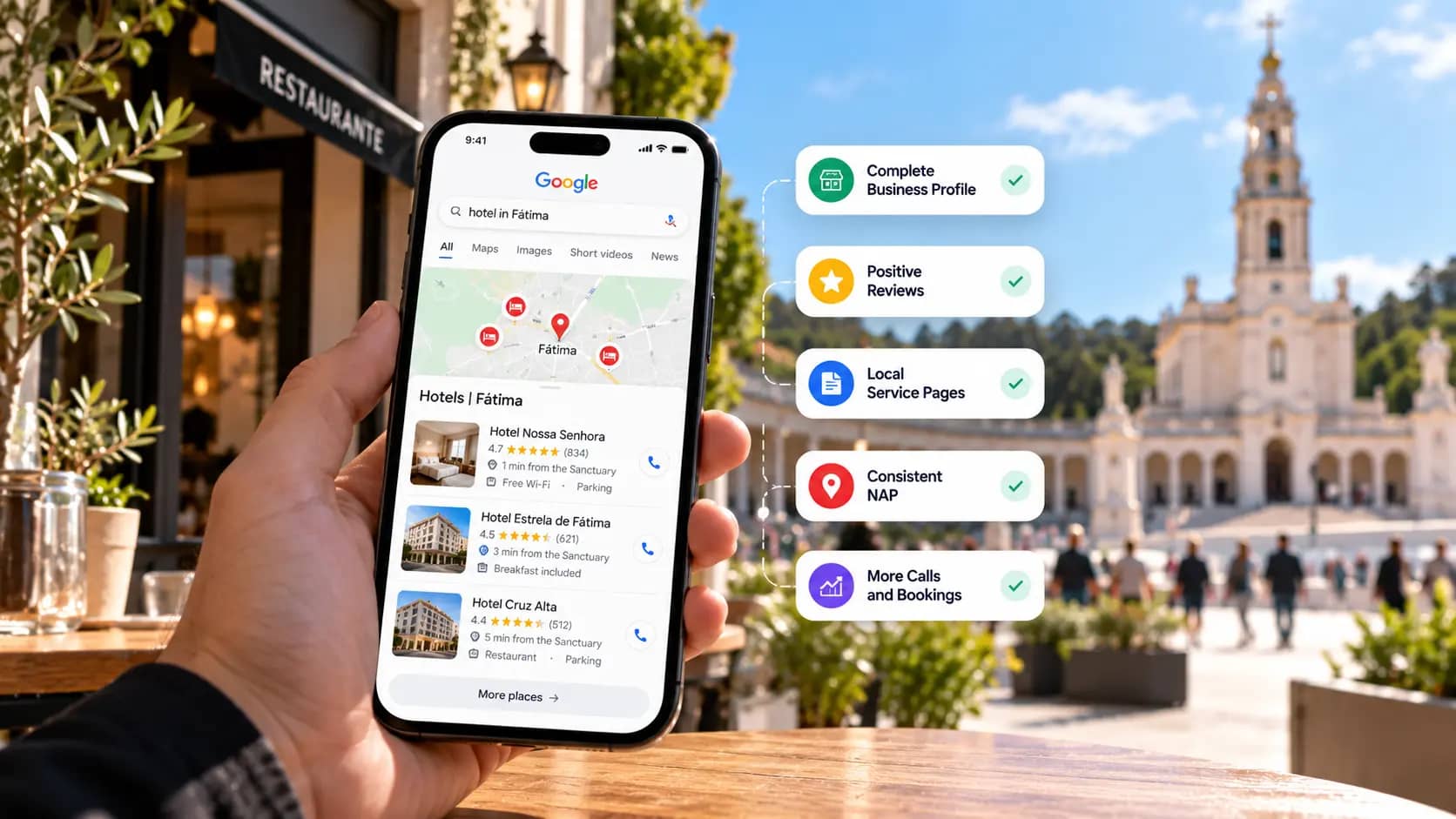
When someone searches for “restaurant near me” or “hotel in Fátima”, Google first shows a map with three businesses. This guide explains how to get into that group and stay there.
Google’s local pack, the block with a map and three results, gets a significant share of clicks on searches with local intent. For a hotel, a restaurant or a clinic, being there is worth more than the top organic position.
In Fátima, competition for that space is especially fierce. There are many hotels, restaurants and shops within a few minutes’ walk of the Sanctuary, and many visitors search once they are already in town, on their phone, in Portuguese, Spanish, French, English or Polish. The good news is that local SEO still rests on a handful of principles, almost all within reach of a small business.
1. A complete Google Business Profile
The right primary category, up-to-date hours, recent photos and a description that says exactly what you do and where. It sounds basic, but most profiles we analyse in Fátima are missing at least three fields.
Choosing the primary category
The primary category carries more weight than any other field. Pick the most specific one: “Hotel” beats “Lodging”, and “Portuguese restaurant” beats “Restaurant”. Secondary categories are there to complete the picture, not to try to show up for everything.
The fields that are usually missing
- Special hours: public holidays, major pilgrimage days and closures for holidays. A customer who finds the door closed won’t trust the profile again.
- Attributes: accessibility, parking, Wi-Fi, languages spoken, vegetarian options. Customers use these as filters.
- Products and services: with a name, a short description and, where it makes sense, a price.
- Photos: exterior, interior, team, rooms or dishes. Real, recent photos, not stock images.
- Website link: to the most relevant page, not always the home page.
Review the profile at least once a month. Google accepts suggested edits from any user, and doesn’t always approve them with good judgement.
2. Reviews: volume, pace and replies
Google values recent, steady reviews. Ask for them at the right moment, with a direct link, and reply to all of them, including the negative ones, politely and promptly.
The right moment is when the customer is happy: at check-out, at the end of the meal, when the job is delivered. A card with a QR code at reception or a message the next day, with a direct link to leave a review, works better than a generic request on social media.
Don’t buy reviews or offer discounts in exchange for them. Besides breaking Google’s rules, profiles with artificial reviews end up penalised or see their reviews removed.
Replying matters too. A thoughtful reply to a negative review shows people who are still deciding that someone on the other side cares. If you host foreign visitors, reply in the language the review was written in.
3. Service pages with local intent
Every main service deserves its own page on your site, with the place name in the title, the H1 and the text, without overdoing it. A page called “Accommodation near the Sanctuary of Fátima” answers a specific search.
A good local page isn’t a list of keywords. It answers the real questions people have: how far it is from the Sanctuary, whether there is coach parking, whether groups are welcome, what the opening hours are, how to book. Include a map, photos of the place and, if you have them, customer reviews.
If you work in several towns, such as Fátima, Ourém, Leiria or Batalha, create pages only for the ones where you genuinely have a presence or customers. Copied pages where only the town name changes rarely work and can hurt the site as a whole.
And don’t forget versions in other languages. A Spanish or Polish pilgrim searches in their own language, and a carefully translated page, with its own URLs and hreflang markup, faces far less competition than the Portuguese version.
4. Consistent name, address and phone
The same name, address and phone number everywhere: website, Google, Facebook, directories and booking platforms. Small differences confuse Google and lower trust.
In practice, choose one official version and always use it. “R. 13 de Maio” and “Rua Treze de Maio” look the same to a person, but not necessarily to a system cross-checking data from dozens of sources. The same goes for the phone number (with or without the country code) and the business name (with or without “Lda.”).
Once a year, list the directories where your business appears, including old ones you no longer control, and ask for wrong listings to be corrected or removed.
5. Measure what matters
Calls, direction requests and clicks to the website, month by month. These numbers, not your ranking on any given day, tell you whether the work is paying off.
The Business Profile itself shows these metrics. Add your website conversions, such as bookings, forms submitted or clicks on the call button, and always compare against the same month of the previous year. In Fátima, seasonality is so strong that comparing May with February tells you nothing.
Be wary of reports that only show rankings. Map rankings change depending on where the search is made: someone next to the Sanctuary sees different results from someone in Ourém or Batalha.
Where to start
If you only have an hour this week, use it to complete your Google Business Profile and reply to any unanswered reviews. If you have a month, add a well-made local service page and a simple process for asking for reviews.
Want to know how your profile is doing? We’ll run a free analysis of your local SEO and send three priority improvements within 48 hours. Request your analysis or explore our local and technical SEO service.

Saadia Ait Iflach
SEO and Digital Marketing