
In this article
To get started with email marketing in a small business, build your own list with clear consent, choose a sending tool that suits your volume, set up an automatic welcome message and regularly send content that’s useful to the people receiving it. Measure opens and clicks, but above all the enquiries, bookings and sales each send generates.
Email is still one of the few channels you fully control: the list is yours, it doesn’t depend on algorithms and it reaches people who have already shown interest. For a hotel, a restaurant, a shop or a service business in central Portugal, it’s often the channel with the best ratio of effort to return. This guide explains how to get started without making mistakes.
Why email still works
- The list is yours. If a social network changes its rules or your account is blocked, you lose access to your followers. Your email list stays with you.
- It speaks to people who already know you: customers, guests, people who asked for information. They are the audience most likely to buy again.
- It’s cheap per contact, especially compared with paid advertising.
- It can be automated: a good welcome or after-sales message works for you every day.
Step one: a list built on consent
What the law says
In Portugal, sending marketing communications by email to individuals generally requires prior, express consent, under Article 13-A of Law No. 41/2004 (in Portuguese). There is a limited exception for customers: if you obtained the email address in the context of a sale, you may send them communications about similar products or services, provided you gave them the chance to refuse, easily and free of charge, when you collected it and in every message.
In practice:
- Never buy email lists. As well as being illegal in most cases, it damages your sending reputation and your emails start landing in spam.
- Don’t add contacts from business cards or quote requests to your newsletter without consent.
- Use a dedicated consent box on your forms, not a pre-ticked one.
- Keep proof of when and how each person signed up.
- Always include a simple way to unsubscribe.
We cover the rules for forms and privacy policies in our guide to cookies and GDPR on your website.
Where to collect contacts
- A newsletter form on your website, with a clear promise of what subscribers will receive and how often.
- At the point of purchase, booking or check-in, with consent.
- At the counter or the table, with a QR code linking to a form.
- At events and trade fairs, with a proper sign-up.
A concrete offer helps: a useful guide, a perk on the next booking, early access to news. But the promise has to be kept in the emails that follow.
Choosing a tool
There are many email marketing platforms, with free or cheap plans for small lists. More than the brand, check:
- Pricing by number of contacts and sends, over 12 and 24 months.
- Automations included in the plan: welcome, birthdays, post-purchase.
- Integration with your website, online shop or booking system.
- A simple editor and templates that work well on mobile.
- Where the data is stored, and whether the provider offers a GDPR-compliant data processing agreement.
- Automatic management of consents and unsubscribes.
Never send campaigns from your normal mailbox, with dozens of recipients in copy. As well as exposing everyone’s addresses, it’s the quickest way to get your domain flagged as spam.
Reaching the inbox
The major email providers have become stricter with bulk senders. To keep your emails out of spam:
- Authenticate your domain with SPF, DKIM and DMARC. Your sending tool explains how; it’s a one-off setup on the domain.
- Send from your own domain, not from a free address.
- Make unsubscribing easy, with a visible link and, ideally, one-click unsubscribe.
- Clean your list regularly, removing addresses that bounce or haven’t opened anything in a long time.
- Keep a regular rhythm. Long silences followed by mass sends raise suspicion.
What to send
The essential automations
Start with the messages that run on their own:
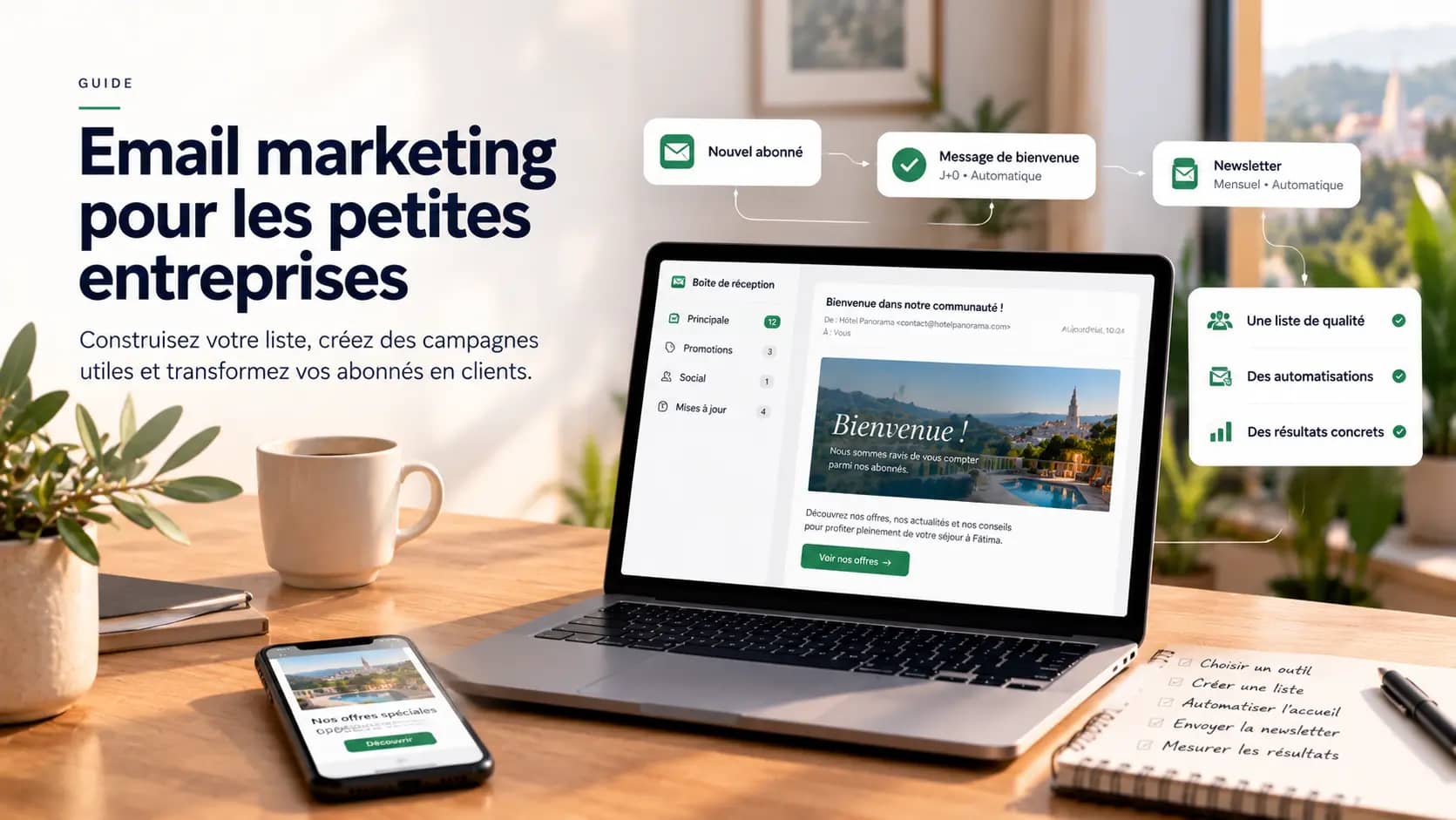
- Welcome: sent straight after sign-up, it introduces the business and delivers on the promise made in the form.
- Post-purchase or post-stay: says thank you, asks for a review and suggests the next step.
- Re-engagement: for customers who haven’t bought or booked in a long time.
- Important dates: the customer’s birthday, the anniversary of their first purchase or, for accommodation in Fátima, the weeks before the major pilgrimages in May and October.
For accommodation providers, the post-stay message is especially valuable: it’s the most direct route to the next commission-free booking. We talk about this in our guide to direct bookings.
The newsletter
A monthly newsletter is a good rhythm for most SMEs. Some ideas:
- Concrete news: products, menus, services, opening hours.
- Useful advice related to what you sell.
- Behind the scenes: the team, suppliers, the process.
- What’s on: events, seasons, time-limited offers.
A good example of a content-led newsletter is the one for the Bahja Spirit cultural calendar, which we designed for Visit Marrakech: every send is a useful selection, not just a promotion.
Writing emails people open
- A short, specific subject line that says what’s inside.
- One goal per email, with a clear button.
- Short copy, written for mobile.
- A recognisable sender, using the business name or the name of someone on the team.
- Personalisation in moderation: a first name helps; segmenting by interest helps far more.
If writing isn’t your strong point, copywriting makes a big difference to opens and clicks.
Measure what matters
Tools show open rates, clicks and unsubscribes. They’re useful, but handle them with care: some email apps open messages automatically to protect privacy, which makes open rates less reliable than they used to be.
Focus on:
- Clicks and what happens next: visits, enquiries, bookings, purchases.
- Revenue or conversions attributed to each send, with tagged links for Google Analytics.
- Unsubscribes and spam complaints, which tell you whether you’re sending too much or the wrong thing.
- List growth, month by month.
To link email to the return from other channels, see our guide on how to measure Google Ads ROI: the measurement principles are the same.
A plan for the first four weeks
- Week 1: choose the tool, authenticate the domain, review your forms and consent.
- Week 2: write and switch on the welcome message.
- Week 3: create the post-purchase or post-stay automation.
- Week 4: send the first newsletter and plan the calendar for the next three months.
If you’d rather hand it over, our email marketing and automation service takes care of the setup, the automations and the regular sends, always in your business’s voice.
Frequently asked questions
Can I send newsletters to my customers without asking permission?
In some cases, yes: if you obtained the email address through a sale and you send communications about similar products or services, provided you gave the customer the chance to refuse when you collected it and in every message. For people who aren’t customers, you need prior, express consent. If in doubt, ask for consent.
How often should I send emails?
Once a month is a good starting point for most small businesses, plus the automations that trigger on their own. Online shops with lots of new products can send more often. The warning sign is a rise in unsubscribes: if they go up after every send, you’re sending too much or content that isn’t useful enough.
How big does my list need to be to make it worthwhile?
There’s no minimum. A small list of real customers, who know you and chose to receive your emails, is worth more than thousands of uninterested contacts. Many tools are free or cheap for small lists, so you can start now and grow over time.
Why do my emails end up in spam?
The most common causes are a domain not authenticated with SPF, DKIM and DMARC, sending from free addresses, lists with lots of invalid addresses, or contacts who never asked to receive emails. Fix the authentication, clean your list and only send to people who have given consent.

Saadia Ait Iflach
SEO and Digital Marketing