
In this article
Changing your brand is a big decision. A new identity can modernise the business, open doors to new customers and bring the image in line with what the company has already become. But it can also confuse the people who know you and, in a few weeks, lose trust that took years to build.
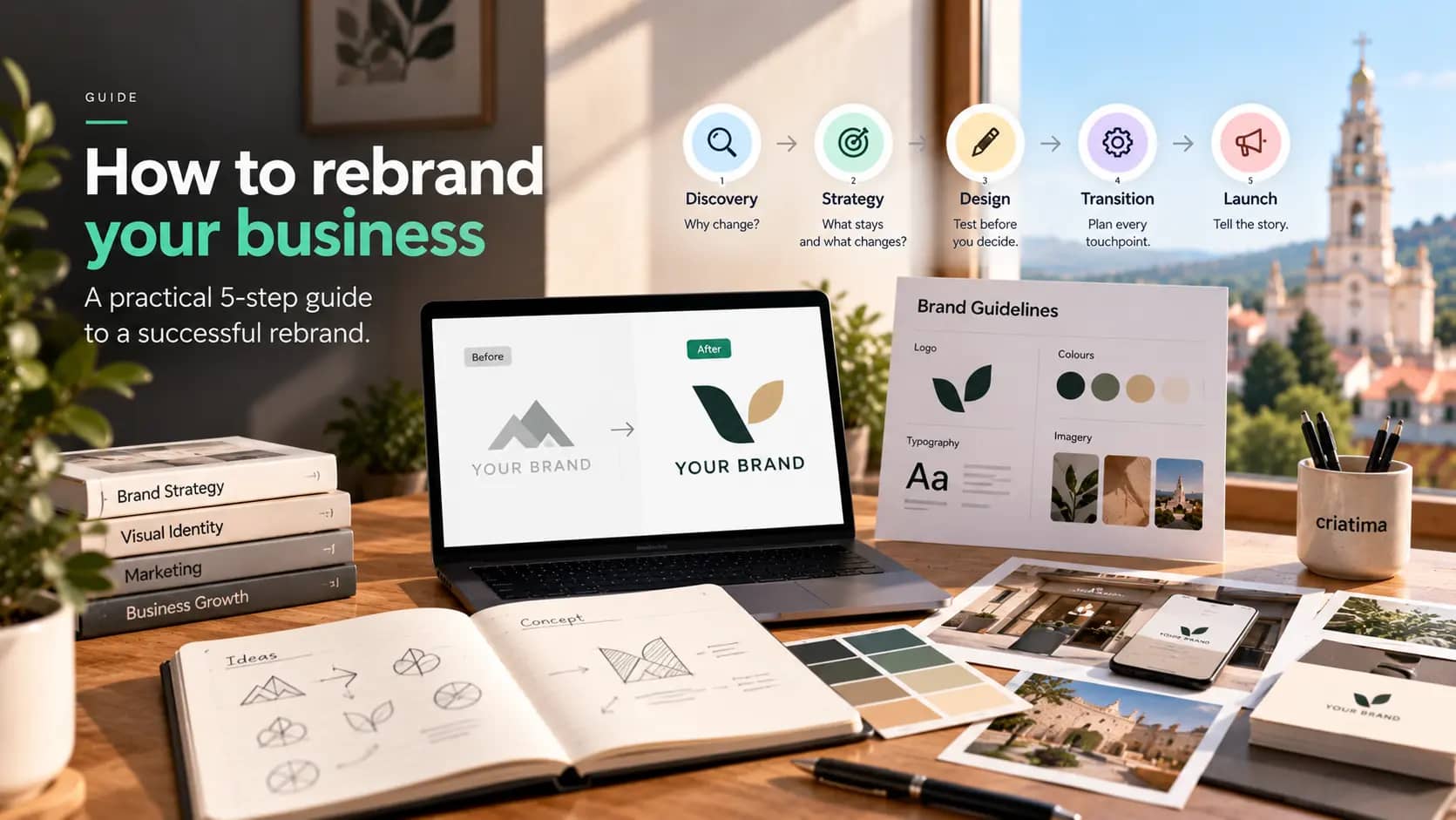
The difference between a rebrand that goes well and one that goes badly rarely lies in the logo. It lies in the process. In this guide we break that process into five phases, with the questions to ask at each one.
1. Discovery: why do you want to change?
Before you open any design software, answer honestly: what isn’t working in the current brand? The most common reasons are legitimate: the company has grown and the image now feels too small, the services have changed, there’s a merger, a new market, or a name that can’t be registered or pronounced in other languages.
There are weak reasons too: the new director wants to leave a mark, the competition has rebranded, or everyone is simply tired of the logo. Remember that your team sees the brand every day, but your customers don’t. What feels worn out to you may, to them, be a sign of trust.
At this stage, listen to the people who matter. Talk to long-standing and recent customers, to the sales team and to whoever answers the phone. Ask what they associate with the company, what words they use to describe it and why they chose it. Their answers will tell you what to change and, above all, what not to touch.
2. Strategy: what stays and what changes
Any brand with some history has assets customers recognise: a colour, a symbol, a name, a phrase, even a tone of voice. Before designing anything, list those assets and decide, one by one, whether they stay, evolve or go.
This is where you choose between evolution and revolution. An evolution keeps the recognisable elements and modernises the rest, and is almost always the safer path for a business with a loyal customer base. A revolution makes sense when the old brand is tied to something you want to leave behind, or when the company has changed so much that the previous image no longer says anything about it.
Write the positioning on a single page: who the brand is for, what it promises and what sets it apart. That document becomes the yardstick for judging every design proposal, instead of the personal taste of whoever is in the room.
3. Design: test before you decide
With the strategy in place, the design has a clear goal. Ask for proposals that show the brand in real situations, such as the website on a phone, the shopfront, an invoice, a social media post or the Google profile, not just a logo on a white background.
Test the final proposals with a few trusted customers. Not so they can vote for their favourite logo, but to check that they still recognise the company and that the new image conveys what the positioning promises.
The outcome of this phase should be a system, not a file: logo and variants, colours, typography, layout rules, tone of voice and application examples, brought together in brand guidelines any supplier can follow.
4. Transition: plan every touchpoint
This is the phase where many rebrands lose customers, not because of the new image, but because the change happens piecemeal. For months two brands coexist, and customers are no longer sure they’re dealing with the same company.
List every touchpoint and decide the order and date of each change:
- Digital: website, social media profiles, Google Business Profile, email signatures, booking or sales platforms.
- Physical: shopfront, signage, vehicles, uniforms, packaging.
- Documents: invoices, proposals, contracts, stationery and business cards.
If the name or domain changes, the website needs special care so you don’t lose your Google rankings: 301 redirects from every old page to its new equivalent, updates to your Business Profile and directory listings, and a change of address notice in Google Search Console. Keep the old domain live and redirecting for a long time.
5. Launch: tell the story
Customers accept change well when they understand the reason for it. Explain what has changed, why it has changed and, above all, what hasn’t: the same people, the same service, the same contact details.
Tell your existing customers first, by email or in person, before the public announcement. Nobody likes finding out on social media that the company they’ve worked with for ten years has changed its name. Prepare your team as well, because they’ll be the ones answering questions.
During the first few months, watch the signals: searches for the old and new names, website traffic, enquiries received and customer feedback. If something is causing confusion, there’s still time to adjust.
In short
A good rebrand changes how the company is seen without changing what customers trust it for. Listen before you design, decide what to keep, test in real situations, plan the transition touchpoint by touchpoint and tell the story to the people who already know you first.
At Criatima we support the whole process, from discovery to brand guidelines and their application on the website and physical materials, as we did for Planet Enchères, from business card to reception. Explore our branding and visual identity service or talk to us about your brand.

Aya Ahansal
Design and Social Media