
In this article
To choose a digital marketing agency, start with your business goal, ask for proof of similar work, find out who will actually do the work and insist on metrics tied to sales or enquiries, not “likes”. Then make sure the logins, the domain and the ad accounts are held in your company’s name. Everything else, price included, follows from there.
A poor choice is expensive: months of work with no results, accounts you don’t control and, often, the feeling that digital marketing “doesn’t work in my sector”. This guide helps a small or medium-sized business compare agencies on objective criteria, whether you are in Fátima, Leiria, Ourém, Tomar or anywhere else in Portugal.
Start with your goal, not with the agency
Before the first meeting, write down in one sentence what you want to have changed in your business a year from now. “More direct bookings in the low season”, “more quote requests for renovations around Leiria” or “selling online beyond our district” are goals an agency can work with. “Being on social media” or “having a new website” are means, not ends.
This simple exercise has two advantages. First, it forces the agency to answer your problem instead of selling you whatever package it has on the shelf. Second, it gives you a yardstick to judge, six months from now, whether the investment is paying off.
If you’re not yet sure where to begin, that’s exactly what a digital strategy phase is for: a diagnosis of your starting point, your competitors and the channels with the most potential, before a single euro is spent on execution.
The criteria that really matter
Experience with your type of business
An agency that has worked with hotels knows what a booking engine and a channel manager are. One that has worked with restaurants knows that the Google listing and reviews carry more weight than a pretty ad. It doesn’t need to have worked for your direct competitor, but it should understand the rhythm and the problems of your sector.
Ask for concrete examples and see them with your own eyes: websites you can open, campaigns they can walk you through, brands you can visit. In our case, the projects are on our work page, with what was done on each one.
Who does the work
Ask who will actually look after your account. It’s common for the sales meeting to be led by an experienced person and for the work then to pass to someone you never speak to, or to subcontractors. That isn’t necessarily bad, but you should know from the outset who your contact is and who does the work.
A clear process, with phases and deliverables
A good agency explains what happens in the first week, the first month and the first quarter. Be wary of proposals that only talk about “management” or “ongoing optimisation” without saying what will be delivered, when, and how it will be signed off.
Metrics tied to the business
Followers, impressions and Google rankings are intermediate indicators. What matters is calls, enquiries, bookings, sales and the cost of each one. Ask which metrics will appear in the monthly report and how they will be measured. If the answer is vague, the report will be too.
Ownership of logins and accounts
The domain, the website, the Google Ads account, the Google Business Profile, Google Analytics and your social media pages should be in your company’s name, with the agency added as a guest user. If you ever change provider, you take everything with you, history included.
Transparent pricing
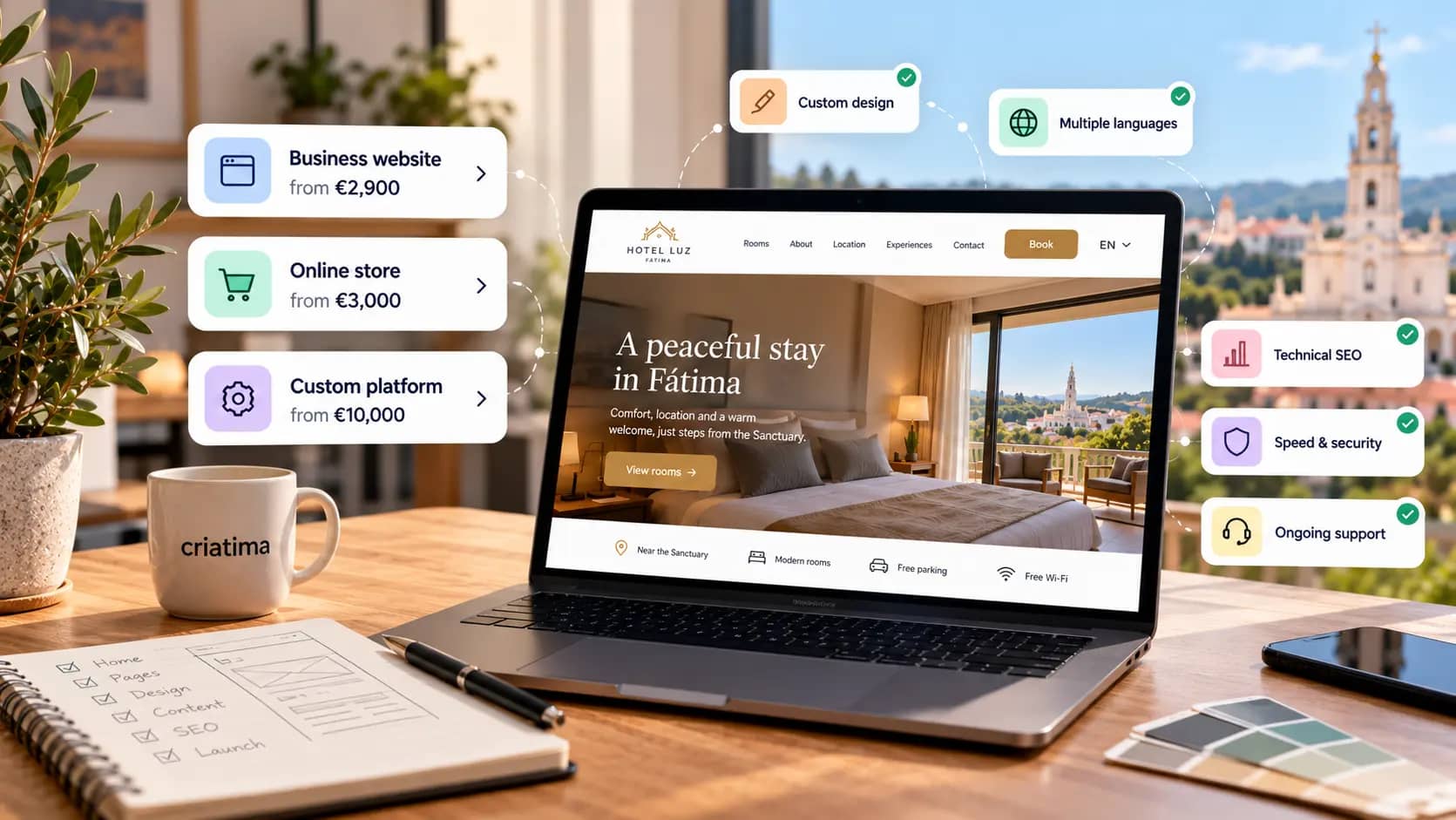
Ask for a breakdown of what’s included and what’s extra: number of hours, posts and revision rounds, and the ad budget kept separate from the agency’s fee. At Criatima we publish our starting prices on our pricing page but, whoever you work with, the key thing is being able to compare proposals on the same criteria.
Proximity and language
For a local business, an agency that knows the region, the source markets and your sector’s calendar saves a lot of explaining. If you work with tourists or international clients, also check that the agency can produce content and campaigns in other languages without relying on machine translation.
Questions to ask at the first meeting
Take this list with you. The answers say a lot about how each agency works:
- What goals do you propose for the first six months, and how will we measure them?
- Who will be my contact, and who does the day-to-day work?
- Can you show me a similar project and explain what went well and what didn’t?
- What access will I have to the accounts and tools? In whose name are they held?
- What is the minimum contract term, and how is it ended?
- What happens in the first 30 days?
- Is the ad budget included in the price or paid separately, directly to the platform?
- Which parts of the work depend on me (copy, photos, approvals), and on what timescale?
A serious agency won’t mind these questions. Quite the opposite: it will usually welcome them, because a client who knows what they want is a client it’s easier to get results for.
Warning signs
Some signs warrant, at the very least, a second opinion:
- Guaranteed Google rankings. Nobody controls the algorithm. An agency can promise good work and honest metrics, not the top spot.
- Ad accounts in the agency’s name. If the Google Ads account isn’t yours, neither are its history and learnings.
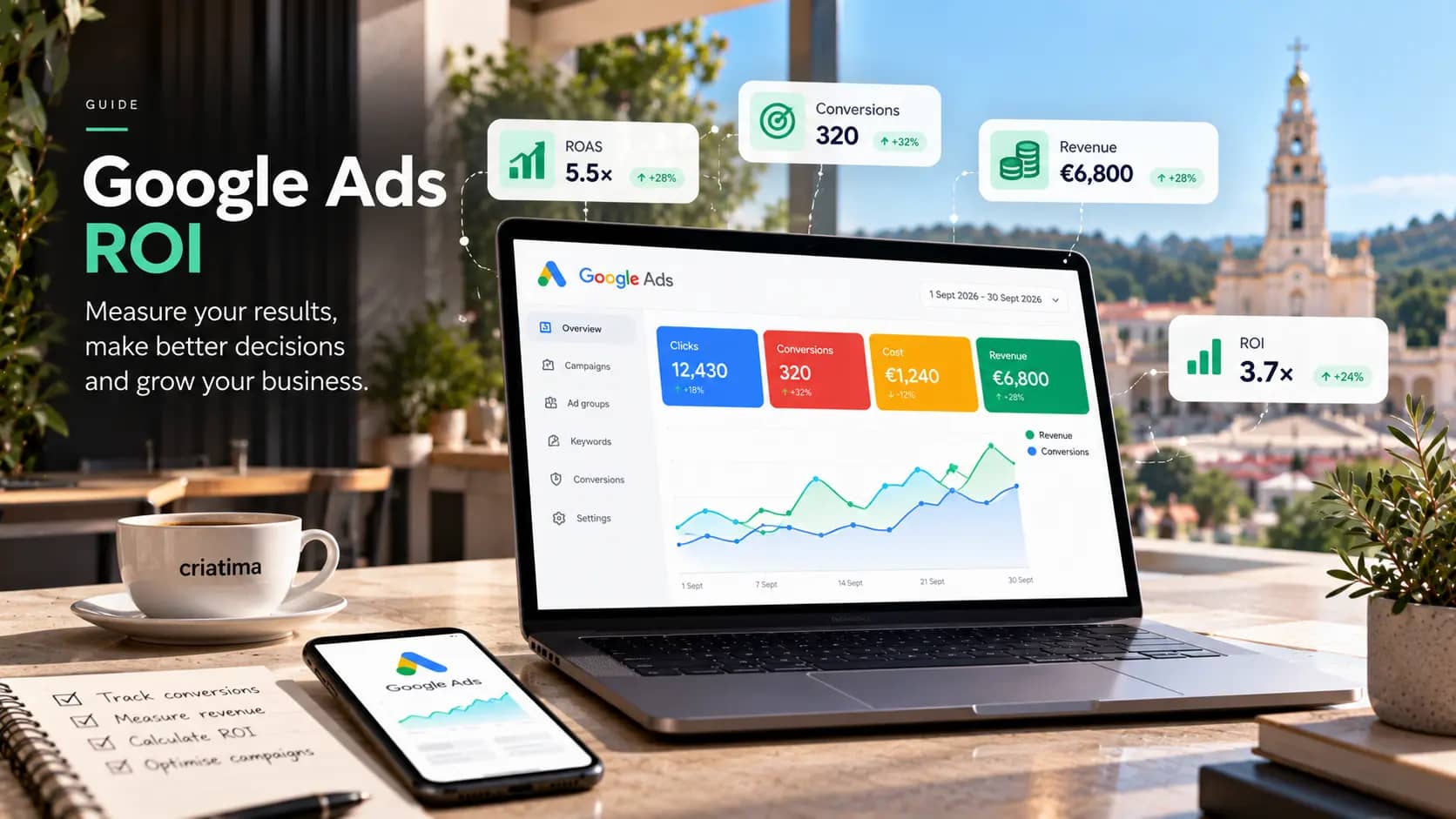
- Reports with nothing but reach charts. Without a link to enquiries, bookings or sales, there is no way to judge the return. Read our guide on how to measure Google Ads ROI to know what to ask for.
- Long contracts with no exit clause. Minimum terms make sense for work like SEO, which takes time to bear fruit, but the exit terms should be in writing.
- The same proposal for everyone. If the proposal says nothing about your business, it wasn’t written for you.
- Prices far below the market. They usually mean something has been left out. Our article on how much a website costs helps you see what is normally included.
Agency, freelancer or in-house team?
There’s no single answer. A freelancer can be the right choice for a well-defined task, such as a logo or a one-off campaign, and is usually cheaper. An in-house team makes sense when the volume of work justifies one or more full-time salaries and there’s someone in the company able to manage it.
An agency tends to pay off when you need several skills at once (website, SEO, ads, design, photography) and would rather have a single contact accountable for the whole. Many SMEs opt for a mix: an in-house person who knows the business and coordinates, and an agency that handles the more technical parts.
A local agency or one from a big city?
Digital work can be done remotely, and there are good agencies all over Portugal. Even so, for a business in central Portugal there are practical advantages to an agency nearby: face-to-face meetings when they’re useful, knowledge of the area and its seasonality, and easy access for photo or video shoots on your premises.
In Fátima, for example, knowing that May and October are months of high demand, or that many visitors search in Spanish, Polish or French, changes how you plan a website, a campaign or a local SEO strategy. But proximity doesn’t replace the other criteria: a weak local agency is still a weak agency.
How to compare proposals
Once you have two or three proposals in hand, compare them point by point:
- Goal: does each proposal address the goal you set?
- Scope: what’s included, in what quantity and how often?
- Timeline: what happens in each phase, and when will you see the first results?
- Measurement: which metrics, with which tools and how often?
- Total cost: agency fee, ad budget, licences and VAT.
- Exit: minimum term, notice period and handover of access.
The cheapest proposal is rarely the most economical. The best one is the one that clearly explains what it will do, why, and how it will prove it worked.
Frequently asked questions
How much does it cost to hire a digital marketing agency?
It depends on the scope. A one-off project, such as a website, has a fixed price; ongoing SEO or advertising support is usually a monthly retainer, plus the budget paid to the platforms. At Criatima, ongoing SEO and digital marketing support starts at €590 a month + VAT, with a six-month minimum commitment.
How long does it take to see results?
Paid ads generate traffic from day one, but they need a few weeks of fine-tuning. SEO takes longer: the first signs usually appear after a few months, and results build with continuous work. Be wary of anyone promising guaranteed organic results within a few weeks.
Should I insist on a contract with a minimum term?
A minimum term is reasonable for services that take time to bear fruit, such as SEO, because the first months are spent on diagnosis and fixes. What matters is that the exit terms are in writing: notice period, and handover of access and of all the work produced to date.
Can a small agency handle everything?
It can, if it has the right skills in the team or trusted partners for the rest. Ask which services are done in-house and which are subcontracted. With a small agency, you tend to speak directly to the people doing the work, which shortens timelines and avoids information getting lost between intermediaries.
If you’d like to compare our approach with other proposals, get in touch. We always start by understanding your business goal before proposing any service.

Radouane Talemsi
Founder and CEO